
Carnation is an important flower and a major contributor to the world’s cut-flower trade. As a result, carnation cultivation is popular among farmers for its long shelf life and ability to survive harsh climates.
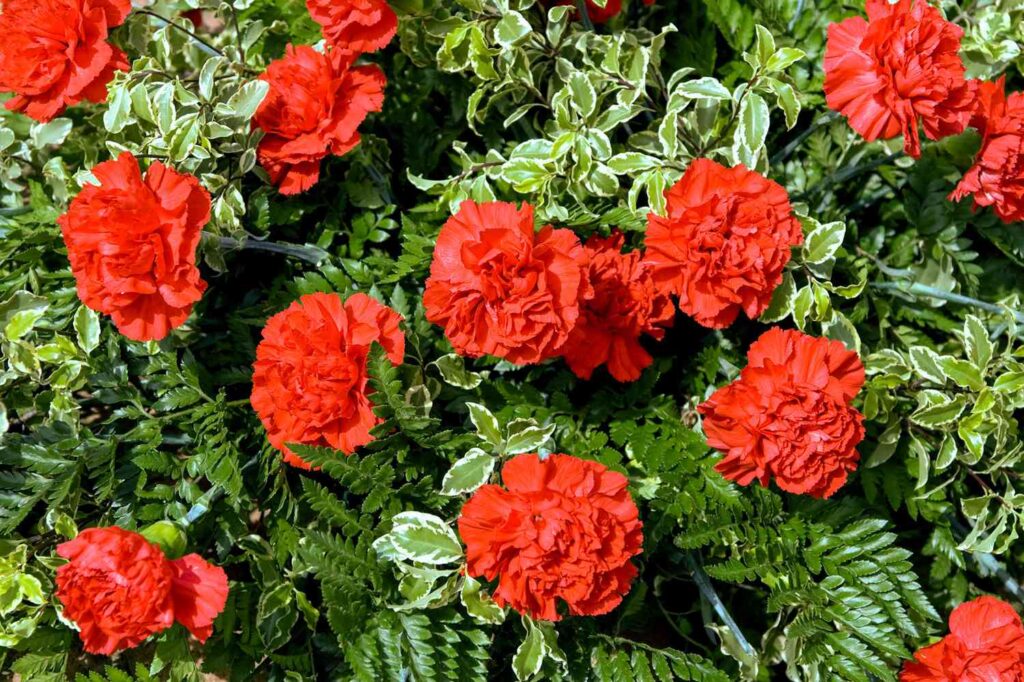
Carnation Cultivation Essential Steps
This blog post will describe the essential steps for carnation cultivation. Also, it will explain the harvesting, yield and benefits of carnation cultivation.
Suitable Season For Carnation Cultivation
Carnation flowers thrive in cool climates. It grows well in low humidity and plenty of sunlight. Standard flowers require cool weather, while spray types may require slightly warmer weather.
Proper Sunlight Is Required For Carnation
Carnation cultivation needs a lot of sunlight, and the crops grow faster on a clear and long day. Generally, flowering starts after the tree reaches 18 pairs of leaves. But if you get more than 4-6 weeks of sunlight, flowers may appear only when there are 4-7 leaf pairs.
Ideal Temperature For Carnation Cultivation
Good quality flowers require full sunlight with equally low temperatures. Moreover, farmers suggest using the New Holland 3600 tractor for carnation cultivation. However, the night temperature should be 10-12°C in winter and 13-15°C in summer. Also, you can get high-quality flowers if the day temperature is around 18°C in Carnation cultivation.
Selecting The Soil For Sowing Carnation
Carnation cultivation can be successful in any type of soil, but the soil must be well-drained. However, Carnations are grown on raised beds or in pots. Its purpose is to ensure proper drainage of water.
Add the proper amount of Nitrogen, Phosphorus and Potash, and compost to the soil for planting. Also, Nitrogen and Potash should be given in two instalments by mixing manure and Phosphorus while preparing the soil. Moreover, Hydrogen peroxide (H2O2) is a chemical used to disinfect soil during Carnation cultivation.
Planting Process In Carnation Cultivation
In carnation cultivation, a 15 x 15 cm space is suggested for the maximum production of high-quality flowers. This way, 49 trees can be obtained per square metre, and you can also use a Kubota tractor for farming because the Kubota Tractor price is reasonable. Moreover, you can plant saplings every two years. Also, the plant should not be planted too deep to prevent diseases.
Fertiliser Needs For Carnation Cultivation
A proper supply of fertilisers is essential for proper growth and high yields of plants. Nutrient deficiencies significantly reduce the quality of flowers and yields, so fertilisers should be given in sufficient quantities. They should be given 200 grams of Nitrogen, 60 grams of Phosphorus, 200 grams of Potash, 125 grams of Calcium and 40 grams of Magnesium per square metre.
Application of 200 ppm Nitrogen and Potassium in Carnation cultivation at the time of irrigation will result in better plant growth and higher yield. Also, a soil check should be done before sowing, and the appropriate amount of fertiliser should be given.
Providing Support To Carnations Plants
The plants in Carnation cultivation need support; nylon or iron wire is used for this. Proper support management should be done according to the growth of the crop; otherwise, the plants in carnation cultivation may twist, and the growth may stop.
A special cultivation method called Pinching is used to produce quality carnation flowers. Pinching is the process of cutting off the top of a crop.
Moreover, Pinching is essential in Carnation cultivation for good-quality flowers. Generally, after planting 6-7 pairs of leaves or 5 cm from the ground to the first leaf. If growth occurs, the tip of the plant is cut off. The number of lateral branches increases as the top is removed.
Multiple flowers can grow on a single tree by growing a certain branch. This method can be used in standard or spray types. Moreover, flowering starts 3-4 weeks late due to top Pinching in carnation cultivation. However, early morning is considered ideal for pinching as the top of the carnation crop breaks easily at that time.
Disbudding In Carnation Cultivation
Removing immature buds from a plant is called disbudding to enhance plant growth and obtain higher-quality flowers. In spray carnations, only the main bud is removed, and the lower buds can grow. Also, while plucking the main stem of the carnation crop, we must protect the plants from unwanted cuts.
It is necessary to trap at the right time in carnation cultivation. If the trap is delayed, the carnation tree may fall to one side, causing severe damage to its trunk. The result is a severe reduction in flower production. In addition, flower harvesting can be difficult if traps are set too early, so regular crop monitoring is needed to ensure the traps are placed at the right time.
Harvesting Of Carnation Flowers
In a cutting crop, flowering starts from the fourth month after planting, and harvesting is done in the morning. Therefore, when all the petals on a regular carnation flower begin to change colour, it is harvested. Also, when a spray carnation is cut, at least one flower bud should be opened, and the rest should show colour. A sharp knife or scissors is essential to cut the flowers.
For extra production in summer, pruning should be done, keeping the length of the vases short to obtain more flowers again. Flowers should be placed in water immediately after the cutting process for carnation cultivation.
Stay tuned with us to learn more about profitable floriculture.